/images/art2.png

Http Status Code Overview

Reference: https://www.restapitutorial.com/httpstatuscodes.html

⭐︎ -> “Top 10” HTTP Status Code. More REST service-specific information is contained in the entry.

1XX Information

  • 100 continue – Client should continue
  • 101 switching protocols
  • 102 processing (webDAV)

2XX Success

  • ⭐︎200 OK – The request has succeeded.

    General status code. Most common code used to indicate success.

  • ⭐︎201 Created – A new resource has been created and should return a URI.

    Successful creation occurred (via either POST or PUT). Set the Location header to contain a link to the newly-created resource (on POST). Response body content may or may not be present.
HTML5 Overview 🏗

table

table
├── thead
│   └── tr
│       └── th
├── tbody
│   └── tr
│       └── td
└── tfoot
    └── tr
        └── td

Intersection Observer API

const option = {
    root: null,
    rootMargin: '0px',
    threshold: 0.7, // or an array [0.1, 0.2, ...]
};

const callback = (entries, observer) => {
    entries.forEach((entry) => {
        // Each entry describes an intersection change for one observed
        // target element:
        //   entry.boundingClientRect
        //   entry.intersectionRatio
        //   entry.intersectionRect
        //   entry.isIntersecting
        //   entry.rootBounds
        //   entry.target
        //   entry.time
    });
};
const observer = new IntersectionObserver(callBack, option);

observer.observer(nodeOne); //observing only nodeOne
observer.observer(nodeTwo); //observing both nodeOne and nodeTwo
observer.unobserve(nodeOne); //observing only nodeTwo
observer.disconnect(); //not observing any node

When node fulfilled observer option, callback function will run directly

Dynamic Programming Example

Longest common subsequence

This is a typical recursive problem. The pseudocode is:

If S1[i] == S2[j], lcs(S1[i:],S2[j:]) = 1 + lcs(S1[i+1:],S2[j+1:])
else lcs(S1[i:],S2[j:]) = max(lcs(S1[i:],S2[j+1:]), lcs(S1[i+1s:],S2[j:]))

Recursive solution:

int longestCommonSubsequence(string text1, string text2) {
    if(text1.size() == 0 || text2.size() == 0 ){
        return 0;
    }

    if(text1[0] == text2[0]){
        return 1 + longestCommonSubsequence(text1.substr(1, text1.size()-1), text2.substr(1, text1.size()-1));
    }

    return max(longestCommonSubsequence(text1, text2.substr(1, text1.size()-1)),
            longestCommonSubsequence(text1.substr(1, text1.size()-1), text2));
}

Time complexity: O(2^n) Using dp could store the state that already calculate before.

Dynamic Programming 🏗

What is dp problem

DP problem is a programming strategy which use extra space to save time. These problems need to store some state instead of calculate again. For most situation, DP is a strategy to reduce the time consuming for recursive problem.

  1. Memorization
  2. Tabulation

fibonacci example

The classic recursive problem:

const fib = (n) => {
    if (n <= 2) return 1;
    return fib(n - 1) + fib(n - 2);
};

How to memorize :

Go overview 🏗

Download

Go to this link

workspace

Run go env in terminal. The variable GOPATH is the default workspace path. Project should under this folder.

In this workspace, file should structured as how you route your project:

.
├── bin
├── pkg
└── src
    └── <The home web page of version control>
        └── <User name>
            └── <Project name>

Example:

Git overview

Here have some good pictures that is helpful for understanding git and contain the record for git commend

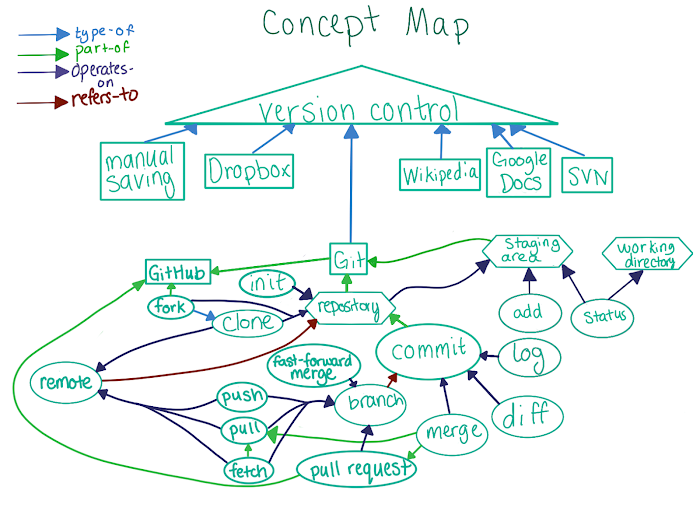
Concept Map

Here is a concept map given by Udacity.com. This picture shows the relationship between these basic git concept.

/images/2019-06-17-gitLearningNote/conceptMap.png

Git Data Transport Map

Git have four working zones. This map shows that using which commend to shift your code from one zone to another.

Vuex Overview

Vuex Document: English 中文

Concept

  • State - App-level state/data
  • Getters - Get pieces of state or computed values from state
  • Actions - Called from components to commit mutation (async)
  • Mutations - Mutate the state (sync)
  • Modules - Each module can have its own state, getters, actions and mutations

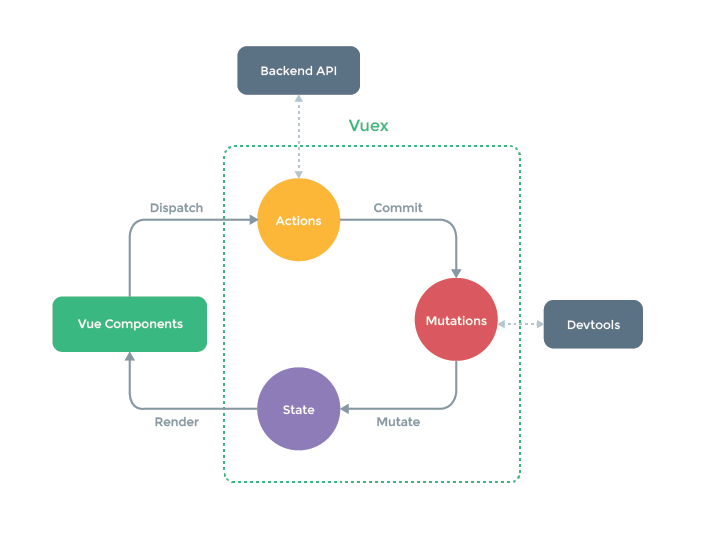
Work flow

Vuex Workflow

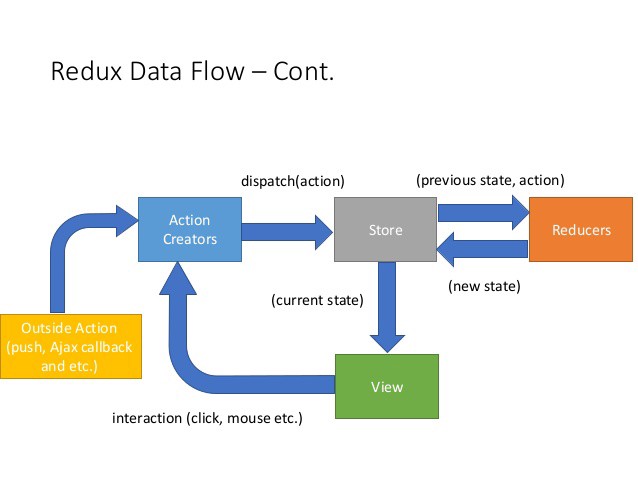
Vuex work flow is similar with Redux => More Detail about Redux

Redux Workflow

Basic structure

In store/index.js

Vue Overview

Vue Document: English 中文

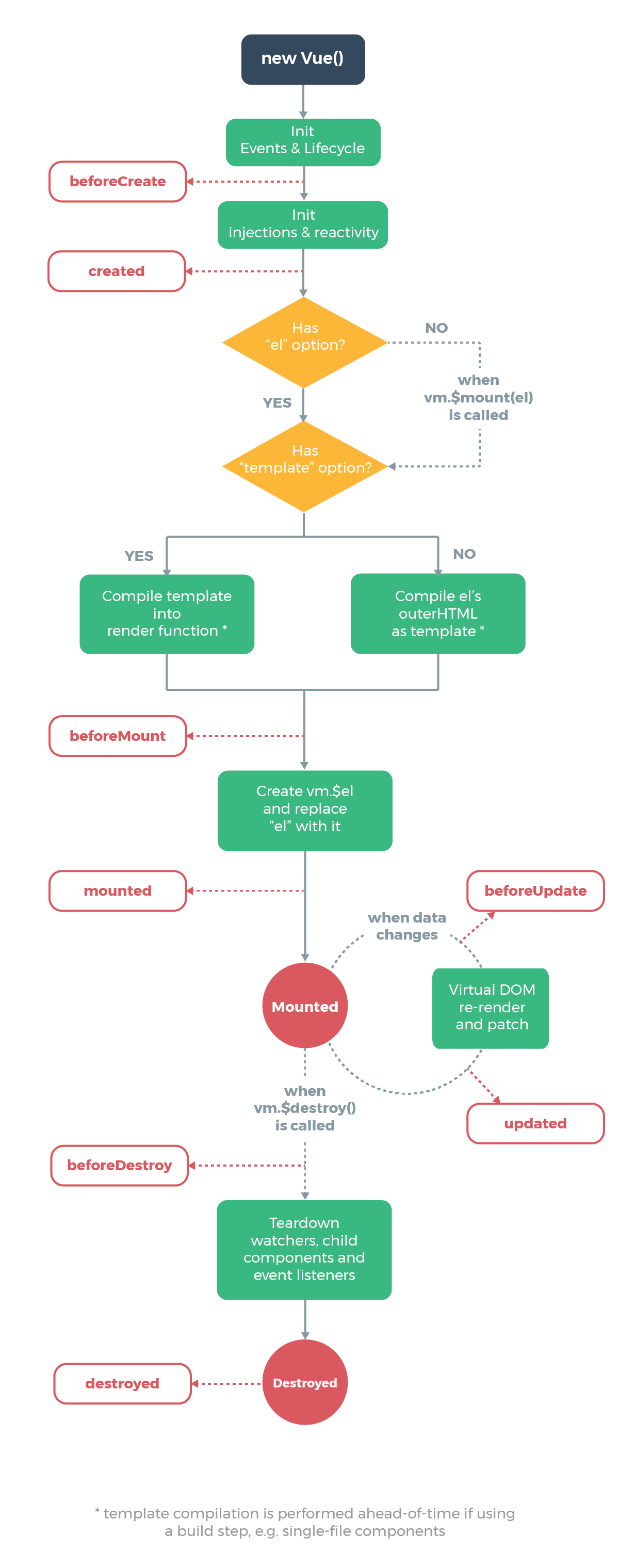
life cycle

/images/2020-05-17-vue/lifecycle.png

Basic structure

<template>
    <div></div>
</template>
<script>
    export default {
        name: '',
        props: [...],
        data() {
            return {};
        },
        computed:{
            ...
        }
        methods: {
            ...
        }
    };
</script>
<style lang="css"></style>

Basic vue function

v-bind

<option
    v-for="(user, idx) in Users"
    :key="idx"
    :value="user.id"
    @mousedown.prevent="multiSelectEvent"
    >{{ user.name }}</option
>

v-bind:value is equal to :value

Js Trick

warning
Many of JavaScript cool feature or syntactic sugar included since ES6(ES2015).

You can read this Article to know What new feature brings in since ES6

Conversion

Any => Boolean

!!false; // false
!!undefined; // false
!!null; // false
!!NaN; // false
!!0; // false
!!''; // false

!!variable == Boolean(variable);

String => Integer

Number('100'); //100
+'100'; // 100

+'abc'; // NAN

Object <=> Array

Array => Object

let arr = [1, 2, 3, 4, 5];

let objFromArr1 = Object.assign({}, arr);

let objFromArr2 = { ...arr };

console.log(objFromArr1); // { '0': 1, '1': 2, '2': 3, '3': 4, '4': 5 }

console.log(objFromArr2); // { '0': 1, '1': 2, '2': 3, '3': 4, '4': 5 }

let pair = [
  ['key1', 'val1'],
  ['key2', 'val2'],
]; // Map works as well

let objFromPair = Object.fromEntries(arr); // ES10

console.log(objFromPair); //{ key1: 'val1', key2: 'val2' }

Object.fromEntries(arr) included in ES10 (ES2019). Before ES10 or convert a complex array, arr.reduce(()=>{}, {}) is a good method

Python Overview

This posts only use as a remainder

Variable

Multiple assignment

x, y, name, is_cool = (1, 2.5, 'a name', True)

Casting

x = str(x)
# x will be string
y = int(y)
# y will be an integer

String

name = 'Brad'
age = 37

print('name is' + name + ' and age is ' + str(age))
print('name is {name} and age is {age}'.format(name = name, age = age))
print(f'name is {name} and age is {age}')

Methods

# Capitalize string
print(s.capitalize())

# Make all uppercase
print(s.upper())

# Make all lower
print(s.lower())

# Swap case
print(s.swapcase())

# Get length
print(len(s))

# Replace
print(s.replace('world', 'everyone'))

# Count
sub = 'h'
print(s.count(sub))

# Starts with
print(s.startswith('hello'))

# Ends with
print(s.endswith('d'))

# Split into a list
print(s.split())

# Find position
print(s.find('r'))

# Is all alphanumeric
print(s.isalnum())

# Is all alphabetic
print(s.isalpha())

# Is all numeric
print(s.isnumeric())

List

A List is a collection which is ordered and changeable. Allows duplicate members.